Restaurants: Answering Every Call During the Dinner Rush
Nearly half of restaurant calls go unanswered — and they cluster at exactly the hours the phone is most valuable. In a business run on 3–5% margins, the phone is the cheapest unexploited revenue channel on the floor.
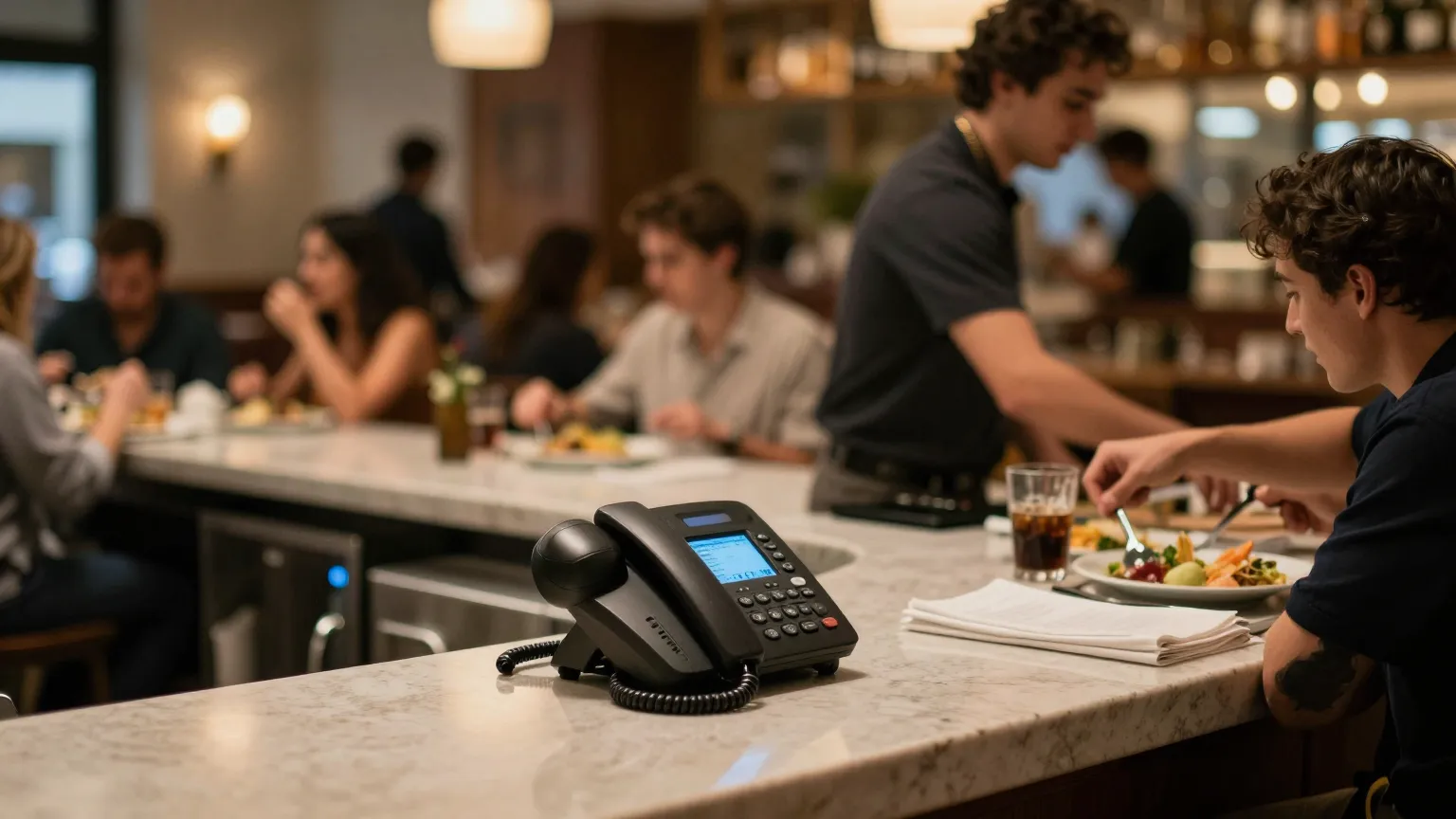
Walk into any busy restaurant at 7 p.m. and listen. Somewhere behind the host stand, a phone is ringing, and nobody can get to it — the host is seating a four-top, the manager is in the weeds, and the line is moving. That ring is a reservation, a takeout order, or a catering lead, and in a business that runs on single-digit margins, letting it go to voicemail is one of the most expensive habits on the floor.
The scale of it is the part operators underestimate. This isn’t a call here and there — it’s a structural leak that peaks exactly when the revenue is richest. This playbook breaks down the number, why it happens when it happens, and how to answer every call during service without pulling a single person off the floor.
The 43% problem and the number behind it
The headline figure is stark: about 43% of restaurant calls go unanswered (Breez, 2025 — vendor-published). Sit with that. Nearly half the people trying to reach the restaurant by phone don’t reach anyone. Some redial, many don’t, and a share of them were about to spend real money.
Vendor analyses put the annual revenue a single busy location loses to those unanswered calls in the low-to-mid six figures — the widely-cited estimate lands around $290,000 a year for a high-volume restaurant. Treat the exact figure as an illustrative model rather than a law of nature, and build your own: your missed-call count, times the average value of a reservation, takeout order, or catering inquiry, times the days you’re open. Even conservative inputs produce a number large enough to embarrass the marketing budget sitting right next to it.
And phone still matters more than operators assume. Around 63% of Americans prefer to call a restaurant directly over an app or web form, and roughly 69% say they’d give up on a place that doesn’t answer (vendor-published, 2025). The phone isn’t a legacy channel to be migrated away from. It’s the channel your best guests are actively choosing — and the one you’re missing.
Peak-hour collision: calls spike when staff can’t answer
The cruelty of the 43% number is whenthe misses happen. Call volume peaks at precisely the hours the floor is busiest — the pre-dinner rush, Friday and Saturday nights, the run-up to a holiday. The same surge that fills your dining room is the surge that buries your phone. Staffing for it is nearly impossible: you can’t justify a dedicated phone-answerer for the slow hours, and during the rush every hand is already committed.
The phone rings hardest at the exact moment nobody can pick it up. That collision, not indifference, is why half the calls go unanswered.
This is the structural nature of the problem, and it’s why it resists the usual fixes. Human staffing is inelastic on a Friday night — you have the people you have. An agent that answers every call simultaneously, whether one is ringing or ten, is the only capacity that actually matches the shape of the demand.
The takeaway
It’s worth naming why the usual workarounds don’t hold. Voicemail is where reservation and takeout intent goes to die — few callers leave one, and the ones who do have often already called somewhere else by the time anyone listens. A third-party ordering app captures some takeout but skims a painful cut of a margin you can’t spare, and it does nothing for the reservation or the catering lead. Adding a dedicated phone person pencils out only if they’re busy all day, and they aren’t — the volume is spiky, not steady. The shape of the problem defeats every fix that isn’t elastic.
Reservations, waitlists, and takeout: three different call flows
“Answer the phone” hides three genuinely different jobs, and a good front line handles each on its own terms.
- Reservations.Check real availability, book the table, capture party size and any note, and send a confirmation. The failure mode to avoid is booking into capacity that doesn’t exist — the agent has to read the real book, not a wish list.
- Waitlist and “how long is the wait?” During the rush this is half the calls. An honest quoted wait time and the option to be added remotely keeps a would-be walk-in from writing you off.
- Takeout.A takeout call is a transaction with a time limit — get it wrong and the order’s cold or lost. Capturing the order accurately and firing it to the kitchen is the whole game, and it’s the flow where a missed call most directly equals a missed sale.
Large parties, dietary restrictions, and private events: the escalation set
Not everything should be handled autonomously, and knowing the line is what separates a useful front line from a liability. A party of two wanting a Thursday table is routine. A party of fourteen, a severe allergy that needs a kitchen conversation, or a buyout request is not — those carry real operational and safety weight and belong with a manager.
The right design handles the high-volume routine calls end-to-end and escalates the high-stakes ones fast, with everything already captured so the manager isn’t starting cold. The guest with the allergy shouldn’t get a scripted reassurance from software; they should get a quick, honest “let me get a manager who can speak to the kitchen” and a warm handoff. That boundary — automate the routine, escalate the consequential — is the same principle that governs every serious AI deployment.
Catering inquiries: the highest-value call most restaurants fumble
If there’s one call worth interrupting anything to catch, it’s the catering inquiry — and it’s the one restaurants fumble most. A catering or private-event lead can be worth ten or fifty times a single cover, and it almost never gets placed at a convenient moment. It comes in mid-rush, or after close, from someone planning an office lunch or a rehearsal dinner who is calling three places and going with whoever responds first.
Miss that call, or bury it in a voicemail box nobody checks until Monday, and the event goes to a competitor. An agent that captures the catering lead the moment it comes in — date, headcount, budget, contact — and routes it immediately to the person who closes events turns the highest-value call in the building from a coin flip into a reliable pipeline. Speed to the lead is the whole difference, exactly as it is in every other business where the first responder wins.
Multi-unit groups: consistent voice across every location
For a group, the phone problem compounds. Every location answers differently, quotes waits differently, and handles catering differently — and the guest experience swings with whoever happened to grab the phone at each unit. Growth makes it worse, not better: by the fifth location the variance is structural and no amount of training fully closes it.
A single agent deployed across locations — reading each unit’s own hours, menu, and booking system while sounding like one brand — makes consistency stop depending on who’s working. Each location keeps its own configuration and calendar; the group gets one voice and one place to see how every unit is actually handling its calls. This is the same multi-location discipline that any growing operator eventually needs: centralize the front line, localize what it knows.
Measuring it: covers per answered call, not calls per hour
The metric most operators reach for — call volume, or how fast the phone gets picked up — misses the point. What actually matters is what the call produced. The number to watch is covers per answered call: of the calls you answered, how many became a booked table, a takeout order, or a catering event.
That reframing does two things. It ties the phone directly to revenue instead of activity, which is the only way it earns attention in a 3–5%-margin business. And it exposes the real cost of the 43% —because every unanswered call is a cover that never had the chance to happen. Measure the outcome, not the ring, and answering every call stops looking like an operational nicety and starts looking like the cheapest revenue channel you own.
| Call type | Handle with | Why |
|---|---|---|
| Reservations & waitlist | Agent, into the real book | High volume, deterministic, peaks during rush |
| Takeout orders | Agent, fired to kitchen | A missed call is a directly missed sale |
| Hours, directions, menu Qs | Agent, end-to-end | Pure deflection off a busy host stand |
| Catering & private events | Agent captures, routes instantly | Highest value; first responder wins the lead |
| Large parties, allergies, complaints | Manager, warm handoff | Operational and safety weight; needs judgment |
Sources
- Breez — restaurant unanswered-call rate (~43%) and lost-revenue estimates (2025). Vendor-published.
- Breez — consumer phone-preference data: 63% prefer calling; 69% abandon after no answer (2025). Vendor-published.
- Invoca — inbound-call value and missed-call benchmarks across service businesses (2024). Vendor-published.
Keep reading
 Speed-to-Lead
Speed-to-Lead in the AI Era: Why 60 Seconds Is the New Standard
Response time is the highest-leverage variable in any appointment- or lead-driven business — and it just became fully automatable. Here's the benchmark, the math, and the operating model that hits it every time.
 Agentic AI
The Agentic CX Playbook: What Changes When AI Answers First
Customer experience used to be a function you staffed. In the agentic era it's a system you design — one where AI handles first contact end-to-end and a human is the escalation path, not the default.
 CX Metrics & ROI
Measuring CX ROI: The Cost-Per-Outcome Framework
Deflection rate, CSAT, and tickets-per-agent are operational metrics dressed up as business metrics. The only number a CFO can act on is cost per booked outcome — and almost nobody reports it.