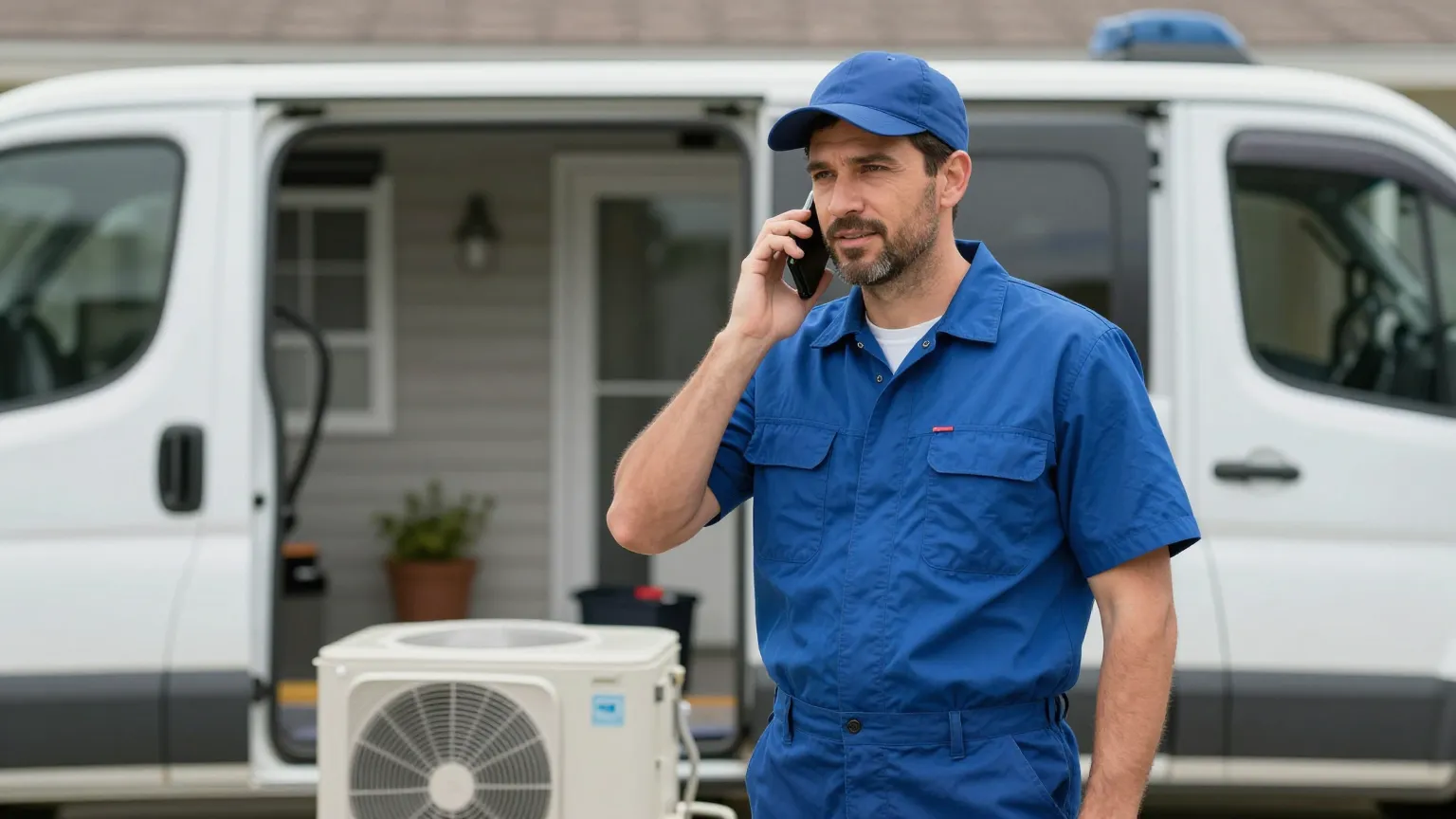
Peak Season Overflow: When Your Best CSR Can't Pick Up Fast Enough
The July heat wave doesn't break your phones because your CSR got worse. It breaks them because of queueing math — calls arrive faster than one line can clear them. Here's how to model that, and how to build the elastic layer that absorbs it.
It’s 2 p.m. on the first 98-degree day of the summer. Your best CSR — the one who books every call, calms every angry homeowner, knows the tech schedule by heart — is on the phone. So are the other two. And right now eleven more people are calling to say their AC just quit. Nobody got worse at their job. The math just changed, and the math doesn’t care how good your team is.
Every HVAC owner has lived this afternoon, and almost everyone misdiagnoses it. It feels like a staffing failure — if we’d just had one more person on the phones. But overflow isn’t a headcount problem you can hire your way out of. It’s a queueing reality: when calls arrive faster than your lines can clear them, a queue forms, and queues behave in ways that are counterintuitive and unforgiving. This is one argument, and it’s the whole article: peak-season overflow is a concurrency problem, not a diligence problem, and the fix is an elastic layer, not another chair.
Why it isn’t a staffing failure
Start with the shape of the demand. HVAC call volume isn’t smooth — it’s spiky in a way few businesses experience. A single heat wave can drive inbound service calls to several times a normal day’s baseline, concentrated into the same afternoon hours, because the whole metro’s equipment fails under the same load at the same time. You are not staffing for your average day. You’re staffing for a curve that spends most of the year flat and then, for a few dozen hours each summer, goes vertical.
Staffing for that peak is economically impossible. If you hire enough CSRs to answer every call on the hottest afternoon of the year, those people sit idle 95% of the season. So every rational shop staffs for something closer to normal load and simply eats the overflow when it comes. The overflow isn’t a mistake in your plan. It’s a designed-in consequence of a plan that’s otherwise correct.
You’re not staffing for your average day. You’re staffing for a curve that’s flat all year and then goes vertical for forty hours in July.
The concurrency math, in plain numbers
Here’s the part that surprises people. A queue doesn’t degrade gently as it fills — it degrades all at once. The relationship between how busy your lines are and how long people wait is not a straight line; it’s a hockey stick. This is the core result of queueing theory (the Erlang C model that every call center is built on), and you don’t need the equations to feel it.
Say each booked service call ties up a CSR for about six minutes — qualify the problem, check the schedule, book the window, confirm the address. With three CSRs, you can clear roughly 30 calls an hour before anyone waits. Push arrivals toward that ceiling and wait times don’t creep up — they explode:
| Calls arriving / hour | Line utilization | Typical caller experience |
|---|---|---|
| 18 | ~60% | Answered almost immediately |
| 24 | ~80% | Short hold, most callers stay |
| 27 | ~90% | Noticeable hold; abandonment climbing |
| 30 | ~100% | Queue never clears; holds spiral, callers hang up |
| 36 | over 100% | Overload — most callers never reach anyone |
Notice the jump between the 80% row and the 100% row. You added six calls an hour — one extra call every ten minutes — and the experience went from “fine” to “phones are on fire.” That cliff is why overflow feels so sudden. Your team was keeping up, and then, with no warning and no drop in effort, it wasn’t. The system didn’t slowly get worse. It hit the knee of the curve.
The takeaway
Where hold time becomes lost revenue
A hold is not a neutral waiting room. It’s a leak. Every second on hold, some fraction of callers hang up — and in home services, a hang-up is rarely a caller who waits and tries again later. It’s a caller who dials your competitor next. Roughly a quarter of inbound calls to home-services businesses already go unanswered on an ordinary basis (per Invoca’s home-services call data, vendor-published), and peak-season overflow is exactly the condition that pushes that number higher.
Do the arithmetic on a single overflow afternoon. If forty calls hit a queue that can only clear thirty, ten callers are living in the hold that never ends. Say six of them give up. In a heat wave, a meaningful share of those were emergency no-cool jobs — the highest-intent, highest-ticket calls you get all year. Miss a handful of those and you’ve lost more revenue in one afternoon than a second full-time CSR would cost you for the season.
This is why “we’ll just call them back” doesn’t rescue overflow. Most missed callers never leave a message and never pick up when you call back, because by then they’ve already booked with whoever answered. The revenue doesn’t wait in the queue for you. It walks.
Designing the elastic layer
If you can’t staff for the peak and you can’t afford to lose it, the only answer left is a layer whose capacity doesn’t depend on how many people are free. The point of that layer isn’t to replace your CSRs on a normal Tuesday. It’s to have effectively unlimited concurrency for the forty hours a year when concurrency is the entire problem — so no caller ever sits in a queue that can’t clear.
Concretely, that layer needs to do three things the moment your lines saturate:
- Answer instantly, with no hold.The eleventh simultaneous caller is greeted in the same second as the first. There is no queue because there is no fixed number of lines — capacity scales to whatever the afternoon throws at it.
- Triage by urgency, not arrival order.A no-cool emergency with an infant in the house and a “what are your hours” question should not be treated identically. The elastic layer qualifies each caller and books the true emergencies into your soonest capacity while handling the routine ones end-to-end.
- Hand off the genuinely human moments warm.When a caller needs a person — a furious repeat customer, a complex commercial job — the handoff carries the full context so your CSR picks up mid-conversation instead of starting from “can I get your name and address?”
Done right, your team stops being a queue that overflows and becomes the escalation path for the calls that actually need them. The routine majority — scheduling, status, tune-up bookings, the standard no-cool intake — gets absorbed instantly, and your best CSR spends the heat wave on the three conversations where being your best CSR actually matters.
What good looks like on the hottest day
Sources
Keep reading